
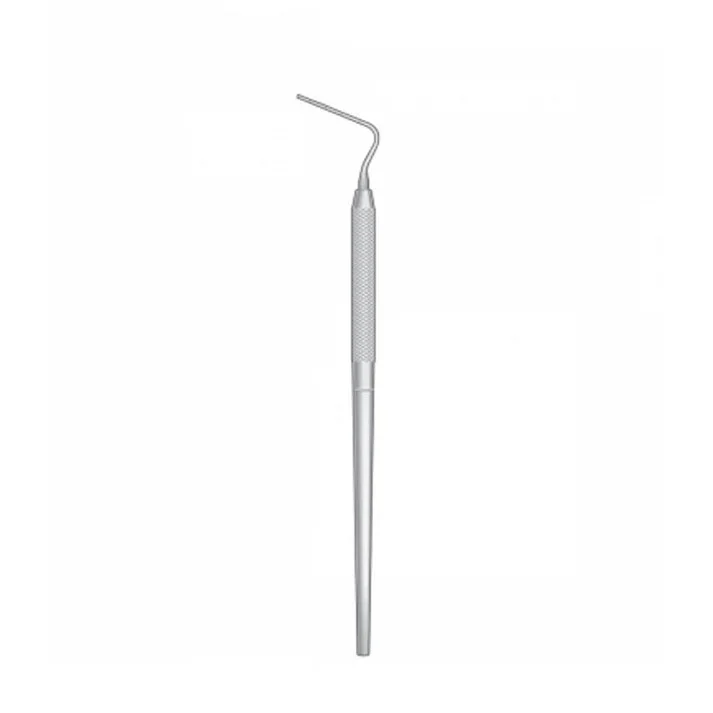
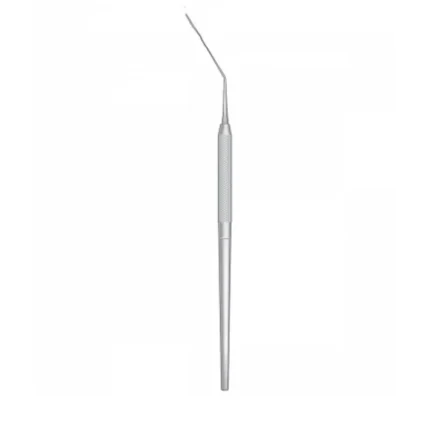
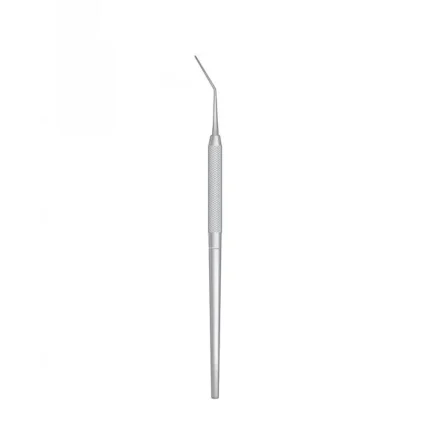

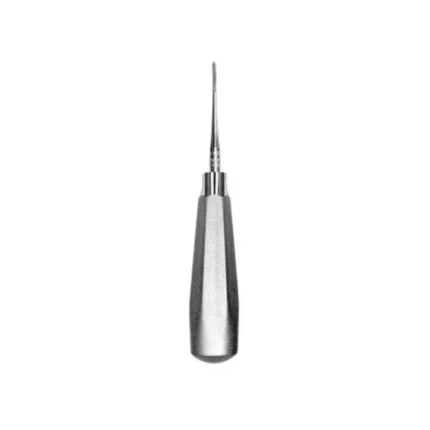
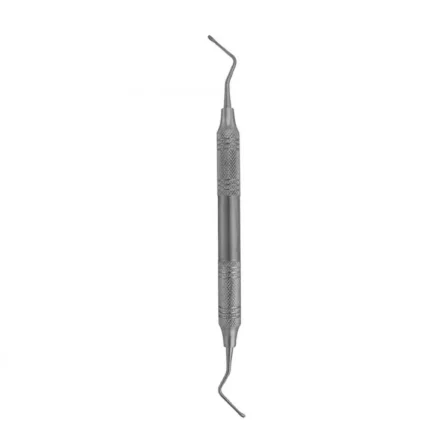
The Posterior Root Canal Plugger in 1.00mm and 1.15mm tip diameters is a medical-grade stainless steel endodontic hand instrument designed for coronal-third condensation and orifice-level compaction of gutta-percha during root canal obturation in posterior teeth — premolars and molars — where the wider canal cross-section at the coronal and mid-coronal levels requires a larger-diameter flat-ended plugger tip to achieve effective full-width gutta-percha condensation without lateral voids or incomplete fill at the orifice. The 1.00mm variant addresses the transition zone between mid-canal and coronal-third compaction in medium-to-large prepared canals, where the 0.9mm plugger has completed mid-canal condensation and a larger contact surface is needed to advance the backfill toward the pulp chamber floor. The 1.15mm variant is the widest common posterior plugger tip size and is used for the final coronal orifice seal and the initial condensation stroke in exceptionally wide posterior canals — including the palatal canals of maxillary molars and the distal canals of mandibular molars — where adequate condensation pressure cannot be achieved with narrower tips. The posterior shank geometry on both variants offsets the working tip from the handle axis to enable apically directed condensation force in posterior teeth without cheek tissue or arch interference. Used by endodontists, general dentists performing molar root canal therapy, and dental residents in endodontic specialty practices, dental schools, hospital dental departments, and general dental offices with a root canal capability. Sold as 1 piece per size variant selected.
1.00mm and 1.15mm Tip Diameters: Coronal Condensation and Orifice-Level Obturation
In the warm vertical condensation technique, a series of pluggers of progressively increasing diameter is used to compact gutta-percha from the apical-most condensation level toward the canal orifice in sequential backfill increments. Each plugger in the series is sized to approximately match the canal preparation diameter at the level where it will be used — wide enough to provide full cross-sectional contact across the gutta-percha mass for uniform condensation pressure, but not so wide that it binds against the canal walls and creates a hydraulic effect that could extrude material apically or crack a thin root. The 1.00mm plugger occupies the coronal-third condensation role in this series, used after the 0.9mm plugger has compacted the mid-canal fill and the backfill gutta-percha reaches the level where the canal preparation has widened to 1.0mm or greater. At this level in a standard molar canal — typically within 2–4mm of the orifice in medium-sized canals — the 1.00mm tip delivers efficient compaction across the full width of the thermoplastic gutta-percha mass. The 1.15mm variant addresses two clinical scenarios. The first is the final orifice-level condensation stroke, where the plugger must seal the gutta-percha flush with the pulp chamber floor across the full canal orifice diameter in wide posterior canals. The second is the initial heat-and-condense step in exceptionally large posterior canals — the palatal canal of maxillary first and second molars, the single large distal canal of mandibular first molars, and the buccal canals of maxillary premolars with large round cross-sections — where the canal preparation diameter at the mid-canal condensation level already exceeds the working capacity of a 0.9mm or 1.00mm plugger. Together, these two sizes cover the full coronal phase of warm vertical compaction in the posterior dentition.
Clinical Application: Coronal Backfill, Orifice Seal, and Molar Canal Anatomy
The clinical context for 1.00mm and 1.15mm posterior pluggers is the coronal obturation phase of root canal treatment in posterior teeth, which presents anatomical challenges distinct from both anterior teeth and the apical compaction phase of the same procedure. Posterior molar and premolar canals flare significantly from the apical constriction to the canal orifice, and the coronal third of a well-prepared molar canal routinely measures 1.0–1.5mm in cross-sectional diameter after rotary or reciprocating instrumentation. Attempting to condense gutta-percha in this zone with a 0.5mm or 0.7mm plugger leaves large areas of the canal cross-section uncompacted, creating marginal voids that allow bacterial microleakage through the coronal seal and ultimately compromise the long-term outcome of the root canal treatment. The 1.00mm and 1.15mm pluggers are specifically dimensioned to match the typical coronal-third canal diameter of prepared posterior canals at the backfill levels where these sizes will be used. The orifice seal step — the final condensation stroke at the level of the pulp chamber floor — is particularly critical in molars because the orifice opening communicates directly with the pulp chamber, and an incomplete seal at this level allows coronal microleakage regardless of the quality of the apical seal achieved with finer-diameter pluggers. The 1.15mm plugger’s wider tip ensures that the gutta-percha is fully compacted across the orifice diameter in wide molar canals, contributing to the coronal seal that, along with the definitive restoration, protects the apical fill from contamination during the period between endodontic treatment and permanent crown placement.
Material, Construction, and Posterior Shank Design
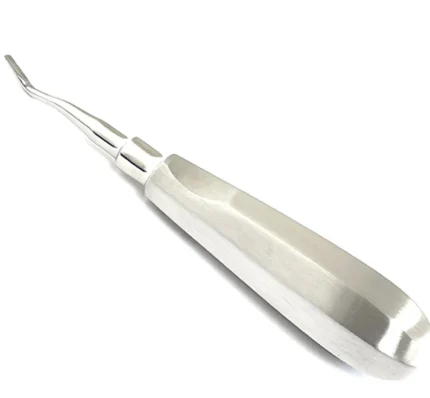
Both the 1.00mm and 1.15mm variants are manufactured from medical-grade stainless steel, providing the corrosion resistance, dimensional stability, and yield strength required for an endodontic hand instrument that undergoes repeated autoclaving and intracanal condensation force cycles across its service life. The flat-ended working tip is machined to precise dimensional tolerances at the stated diameter, ensuring consistent contact area between the tip face and the gutta-percha mass at the condensation level without rounding or tapering at the tip edge that would concentrate force and risk perforation of the gutta-percha fill. The posterior shank design — an offset or angled bend between the working shank and the handle — positions the working tip away from the handle axis so that the clinician can maintain a vertical or near-vertical grip on the handle while directing the tip apically along the canal long axis through the posterior access cavity. This geometry is essential for effective vertical condensation: condensation force that is not directed along the canal axis compresses gutta-percha laterally rather than apically, reducing the density of the apical seal and potentially displacing fill material into lateral canals or apical foramina. The handle is textured for secure grip under clinical conditions. Both sizes are dimensioned with the same handle length and working shank profile, allowing them to be used interchangeably within a single warm vertical compaction sequence without repositioning the rubber dam clamp or changing the operating position.
CE Mark, ISO 13485, and FDA Certification for Dental Instrument Procurement
The Posterior Root Canal Plugger 1.00mm / 1.15mm is manufactured under a quality management system certified to ISO 13485, governing all production stages including raw material sourcing, precision machining of the working tip and shank, dimensional inspection at stated tip diameters, surface finishing, and packaging. CE Mark certification confirms conformity with European Medical Device Regulation requirements for Class I reusable dental hand instruments distributed within EU and associated regulatory territories. FDA compliance documentation is maintained for United States distribution, satisfying regulatory requirements applicable to reusable endodontic hand instruments procured by US dental practices, endodontic specialty offices, dental schools, and hospital dental departments. These certifications satisfy the procurement and tender documentation requirements of institutional buyers in the USA, India, Pakistan, Vietnam, and across international dental supply and tender frameworks. Certificates of conformity and quality management system documentation are available upon request for vendor qualification and institutional procurement submissions. OEM manufacturing and custom tip diameter configurations are available within the same certified manufacturing framework.

Reviews
There are no reviews yet.