
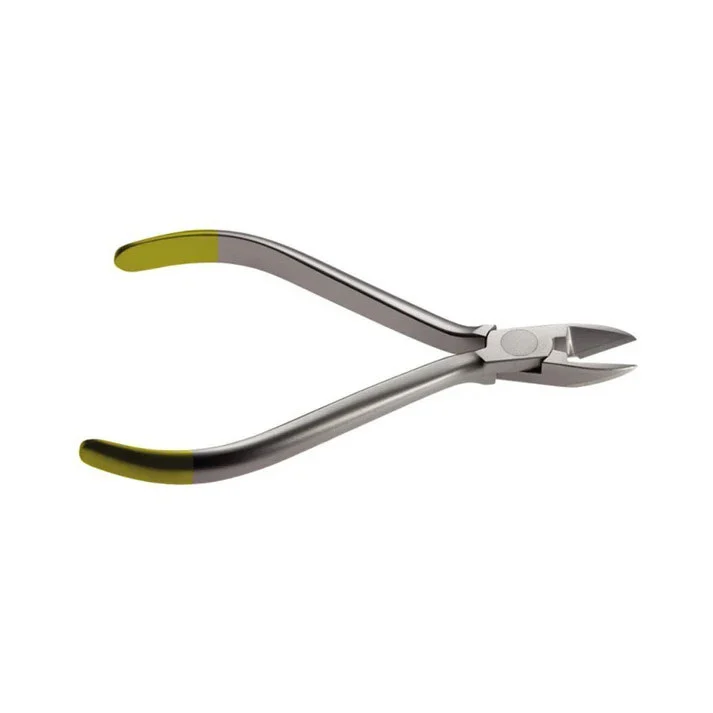

The Hard Wire Cutter from Peak Surgicals is a reusable German Stainless Steel orthodontic cutting instrument with tungsten carbide cutting inserts, designed for controlled trimming of high-tensile orthodontic archwires up to .022″ x .028″ (.56 mm x .71 mm). Each cutter is priced at $16.50 and features non-angled cutting jaws, reinforced TC inserts, a box-joint pivot, curved ergonomic handles, coated distal grip sleeves, short cutting beaks, smooth outer jaw shoulders, and a compact working head for intraoral and chairside appliance adjustment. Orthodontists, dentists, dental residents, orthodontic assistants, hospital dental departments, university clinics, private orthodontic practices, and procurement teams use this cutter during fixed appliance treatment, archwire adjustment, bracket-based mechanics, stainless steel wire trimming, rectangular wire cutting, appliance finishing, emergency wire relief, retainer wire adjustment, and chairside orthodontic maintenance. The non-angled jaw profile gives direct axial cutting control when reducing wire length at bracket ends, molar tube exits, posterior segments, anterior arch adjustments, and extraoral appliance preparation.
Tungsten Carbide Cutting Inserts, Non-Angled Jaws, Pivot Joint, and Handle Geometry
The Hard Wire Cutter uses tungsten carbide inserts at the working edges because rectangular orthodontic wire places high stress on a standard stainless cutting surface. TC inserts resist edge deformation and preserve a defined cutting interface when trimming stainless steel and other high-tensile orthodontic alloys. The non-angled jaw geometry gives a straight working approach, allowing the clinician to align the beaks directly with the intended cut point rather than approaching from an offset direction. This is clinically important when cutting archwire near molar tubes, posterior brackets, buccal segments, and extraoral appliance components where visibility and tip alignment determine the final wire end. The compact head reduces obstruction in the cheek corridor, while smooth outer jaw shoulders help limit unintended contact with brackets, elastomeric ligatures, mucosa, and adjacent teeth. The pivot joint transfers handle force to the short cutting beaks with controlled closure. The curved handles and coated distal grip sleeves support stable finger placement during repeated orthodontic wire adjustments.
Archwire Trimming, Fixed Appliance Adjustment, Emergency Wire Relief, and Retainer Work
During fixed appliance treatment, the Hard Wire Cutter is used to trim distal archwire ends after engagement into molar tubes and brackets. In rectangular archwire sequencing, the .022″ x .028″ capacity supports cutting high-stiffness wires used during finishing, torque control, space closure, and stabilization stages. During emergency orthodontic visits, the cutter helps remove irritating distal wire extensions that contact buccal mucosa, retromolar tissue, or cheek surfaces. In appliance adjustment, the non-angled beaks allow the orthodontist to position the cutting edge close to bracket wings, buccal tubes, stops, hooks, and wire bends without excessive head rotation. During retainer repair or adjustment, it supports trimming stainless wire segments before contouring and polishing. For chairside orthodontic maintenance, the instrument works beside Weingart pliers, distal end cutters, ligature cutters, Mathieu needle holders, bracket tweezers, archwire forming pliers, mirror, cheek retractor, and suction. The tool is selected when a stronger cutting edge is required than a ligature cutter or light wire cutter provides.
.022 x .028 Inch Wire Capacity and Clinical Selection Rationale
The listed .022″ x .028″ (.56 mm x .71 mm) cutting capacity is clinically relevant because this rectangular dimension corresponds to heavy orthodontic archwire use in bracket systems where torque expression, finishing mechanics, and space closure demand a rigid wire profile. A cutter intended only for ligatures or fine round wire is not matched to this load because the cutting edge can deform, flatten, or fail to complete the cut cleanly. The Hard Wire Cutter is selected when the clinician needs to reduce rectangular stainless steel archwires, heavy round wires, retainer components, and extraoral wire sections that require more edge strength than delicate intraoral cutters. The straight jaw format supports clean trimming of posterior segments where access is restricted by cheeks, molar bands, buccal tubes, and second molar positioning. The same capacity also supports extraoral bench preparation before wire placement. This specification makes the instrument appropriate for orthodontic clinics that need a reusable cutter dedicated to heavy wire reduction rather than fine ligature cutting.
German Stainless Steel, TC Edge Integrity, Sterilization, and Dental Procurement Documentation
German Stainless Steel gives the Hard Wire Cutter the structural rigidity, corrosion resistance, and reusable durability required for repeated orthodontic clinic use. The tungsten carbide inserts require precise seating because cutting performance depends on edge alignment, jaw closure, pivot stability, and consistent beak opposition. The polished stainless steel finish supports visual inspection after cleaning and reduces retention points along the handles, joint, and working head. After clinical use, the jaws are opened, the cutting edges are brushed, the pivot joint is cleaned, the handle surfaces are wiped, and the coated grip ends are inspected before steam sterilization by autoclave after complete drying. The instrument should be checked for jaw alignment, edge damage, screw stability, and smooth opening before returning to the orthodontic tray. CE marking, ISO-13485 certification, and FDA compliance support dental clinic purchasing, hospital procurement, distributor documentation, and international tender files. The listed price, reusable format, MOQ of 1 piece, and return-and-replacement support standardized orthodontic wire cutter inventory.

Reviews
There are no reviews yet.