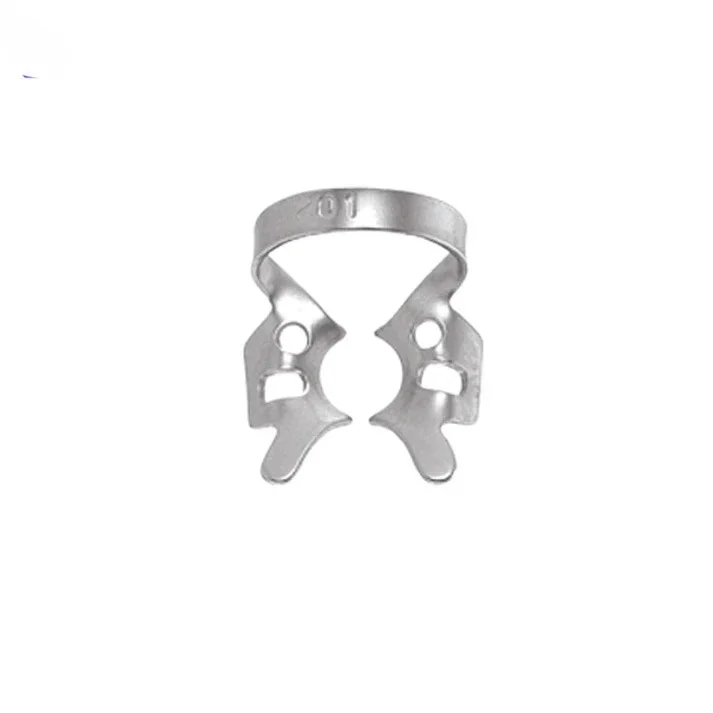
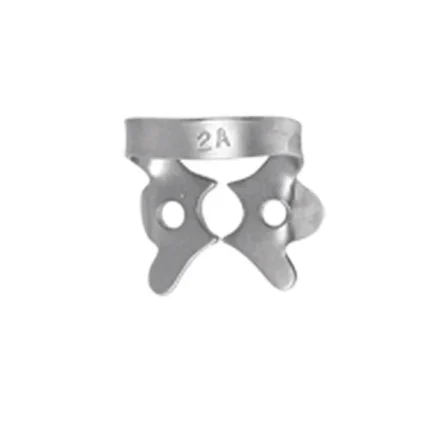
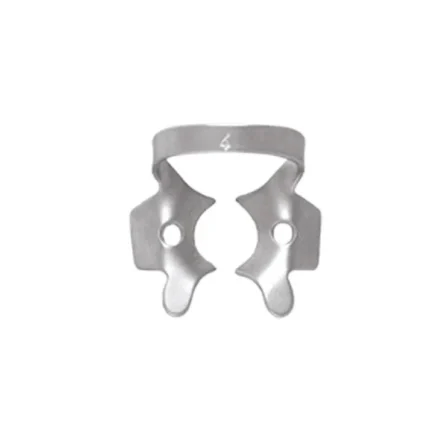

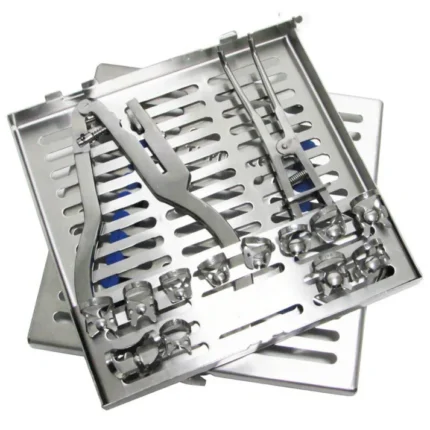
The Winged Clamp Rubber Dam from Peak Surgicals is a reusable stainless steel rubber dam clamp featuring extended lateral wings on the clamp bow that allow the rubber dam sheet to be pre-stretched over the wings and placed simultaneously with the clamp onto the anchor tooth — eliminating the sequential two-step placement required with wingless clamps. Sold as a single piece, this clamp is used by general dentists and endodontists in dental practices, dental schools, and hospital dental departments worldwide.
Wings: The Functional Difference Between Winged and Wingless Clamps
Standard wingless rubber dam clamps are placed onto the anchor tooth first, then the rubber dam sheet is punched, stretched, and pulled down over the bow to seal around the tooth — a two-step process that requires the clinician to seat the clamp, release the forceps, pick up the rubber dam frame and sheet, and then stretch the dam over the clamp bow without dislodging the clamp in the process. Winged clamps eliminate this sequence. The lateral wings projecting from the bow provide a ledge onto which the rubber dam sheet can be pre-stretched before placement — the clamp and dam are loaded together onto the clamp forceps and placed simultaneously onto the anchor tooth in a single manoeuvre. The dam sheet is then lifted off the wings with a flat plastic instrument or burnisher to seat it below the gingival margin and create the seal.
One-Step Rubber Dam Placement Technique with Winged Clamps
The one-step technique enabled by the Winged Clamp Rubber Dam is particularly valued in clinical environments where placement speed and procedural efficiency are important — including high-volume general dental practices, dental school clinical sessions with teaching time constraints, and paediatric dental settings where minimising the number of distinct steps during dam placement reduces patient management time. The technique also reduces the number of times the clinician must return to the instrument tray between clamp placement and dam isolation, keeping clinical workflow uninterrupted from the moment the anchor tooth is selected through to the start of the endodontic or restorative procedure.
Cervical Tooth Engagement and Rubber Dam Isolation Function
The cervical tooth engagement of the Winged Clamp Rubber Dam functions identically to a standard wingless clamp — four jaw tips contact the buccal, lingual, and interproximal cervical margins of the anchor tooth, and the spring tension of the jaws maintains consistent retention throughout the procedure. The wings add to the bow profile for placement purposes only; once the dam is seated below the wings and the clamp jaws are in contact with the tooth, the isolation quality is equivalent to that achieved with a wingless clamp of equivalent jaw profile. The Winged Clamp Rubber Dam provides the same standard of rubber dam field isolation required for root canal treatment, direct restorative procedures, and other moisture-sensitive dental procedures.
Stainless Steel Construction for Repeated Clinical Use
Each Winged Clamp Rubber Dam is manufactured from stainless steel, providing the structural rigidity required to maintain both the jaw geometry and the wing profile across repeated clinical use and sterilization cycles without fatigue deformation. The wings must remain dimensionally stable to support the stretched rubber dam sheet reliably during the one-step placement manoeuvre. Stainless steel construction ensures the clamp is rust-free and compatible with standard decontamination and sterilization protocols used in licensed dental facilities.
CE Mark, ISO 13485, and FDA Certification for Dental Instrument Procurement
The Winged Clamp Rubber Dam is manufactured under CE Mark, ISO 13485, and FDA compliant quality standards. ISO 13485 certification confirms Peak Surgicals operates a documented quality management system covering design control, material traceability, and production consistency for dental instruments. CE Mark confirms conformity with European medical device regulations, and FDA compliance supports procurement for US-based dental practices, dental schools, and hospital dental departments requiring verified regulatory documentation.

Reviews
There are no reviews yet.